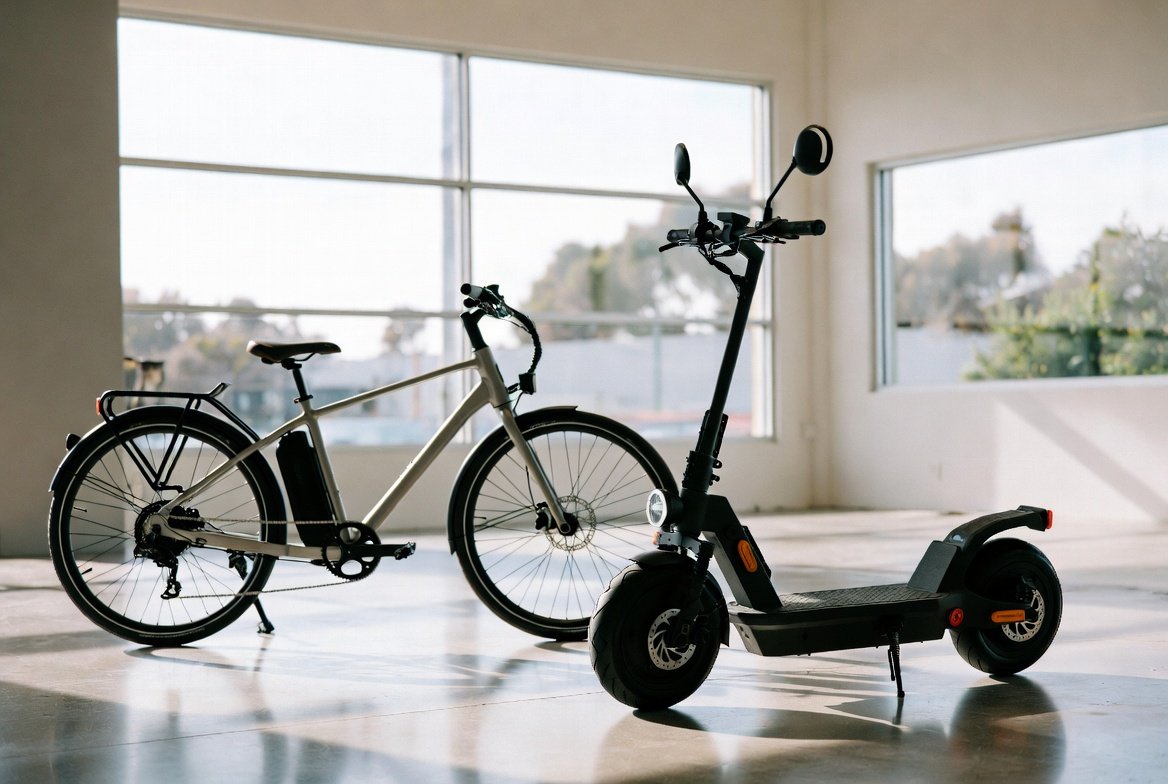
During my MBA work at Capella University, I spent months designing and stress-testing a new retail venture called Aiim Mobility — a hybrid e-bike and e-scooter business planned for Huntington Beach, California. What started as a feasibility analysis, competitive assessment, and financial plan for a new business became something larger: a clear view of where specialty retail is headed.
The pure online model has limits. The pure brick-and-mortar model is under pressure. The winners in the next decade will be the operators who deliberately combine the best of both — physical presence that builds trust and education, paired with digital efficiency that keeps capital light and fulfillment fast.
Why Specialty Retail Still Needs a Physical Presence
Electric mobility products sit in a category that pure e-commerce struggles to serve well. First-time buyers face real uncertainty: battery range, safety features, fit, assembly, and long-term reliability. Research I examined during the Capella coursework consistently showed that perceived risk is one of the biggest barriers to adoption. Customers do not just buy a product; they buy confidence in the outcome.
A showroom changes that equation. It allows demonstrations, guided selection, proper setup, and immediate answers. It also creates a natural path to service and accessories — the higher-margin, relationship-building parts of the business. In my analysis, the primary customer segments (suburban commuters and hybrid workers ages 25–45, recreational riders and families ages 30–55, and first-time electric mobility buyers) all showed elevated need for local expertise and post-purchase support. Those needs are difficult for a distant marketplace or big-box retailer to meet at the same level.
The Hybrid Operating Model That Makes It Work
The model I developed for Aiim Mobility deliberately rejects the traditional retail inventory burden. Instead of buying large amounts of stock, the business relies on manufacturer consignment inventory in the showroom and dropship fulfillment for online orders. This structure delivers several advantages:
- Dramatically lower capital requirements and reduced inventory obsolescence risk
- Competitive pricing because the business is not carrying the full cost of holding product
- Faster delivery on many items while still offering local expertise and service
- Better cash-flow resilience in the early years of the venture
Financial modeling showed that this approach allowed a realistic launch with approximately $85,000 in initial investment and controlled monthly operating costs, while still projecting meaningful gross profit once volume ramped. The physical location (planned at roughly 1,200–1,500 square feet) serves as a hub for education, light service intake, and brand experience rather than a warehouse.
This is not a compromise between online and offline. It is a deliberate design that uses each channel for what it does best.
Competitive Reality and Differentiation
The competitive landscape includes local bike shops, specialty retailers, online marketplaces, and big-box stores. Competing purely on price against Amazon or large chains is a losing strategy for a small operator. Differentiation comes from specialization, education-driven selling, service integration, and accountability — elements that large-scale competitors find hard to replicate consistently at the local level.
Suburban markets, in particular, present strong opportunities. Higher vehicle dependence, rising ownership costs, and growing interest in flexible, lower-cost short-distance mobility create demand that pure online players often fail to convert fully because of the trust and education gap.
Broader Implications for the Future of Retail
The lessons extend beyond electric bikes and scooters. Any category with meaningful complexity, perceived risk, or post-purchase needs — outdoor gear, specialized consumer electronics, home fitness equipment, certain home improvement products — benefits from the same hybrid logic.
Key principles that emerged from the work:
- Trust and education are scarce. In an era of infinite product choice and review overload, the retailer that reduces uncertainty wins.
- Capital efficiency matters more than ever. High fixed inventory costs and long cash conversion cycles are structural disadvantages. Consignment, dropshipping, and modular physical footprints improve resilience.
- Service and community create defensibility. The relationship does not end at the transaction. Service, accessories, and local expertise turn one-time buyers into retained customers.
- Suburban and secondary markets are undervalued. Many digital-first strategies still over-index on dense urban centers. Lifestyle and cost-driven demand in the suburbs is real and growing.
Closing Thoughts
Retail is not dying. It is being forced to become more intentional. The operators who treat the physical store as an experience and education hub, while running the back end with digital-era capital discipline, will outperform both pure online players and traditional high-inventory retailers.
My Capella work on Aiim Mobility was an exercise in applying that principle rigorously — macro environment analysis, customer segment viability, competitive positioning, risk assessment, and conservative financial planning. The conclusion was clear: a thoughtfully designed hybrid model is not only feasible; it is well positioned for the next phase of retail.
The future belongs to retailers who stop choosing between digital and physical and instead design the combination that actually serves the customer.